

Abstract
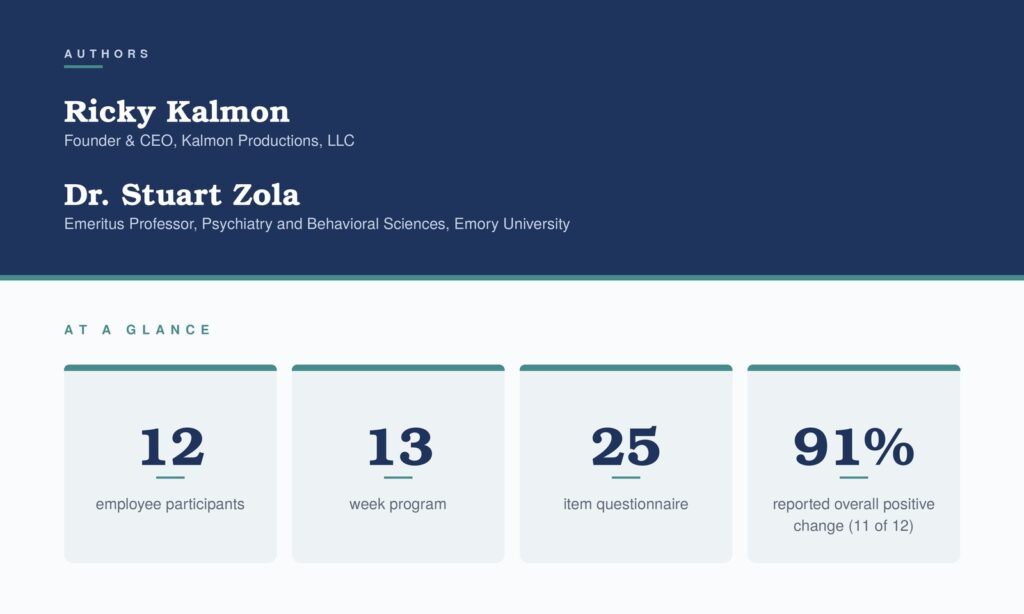
This study explores the feasibility and impact of a 13-week program designed to enhance employee well-being and performance through habit development and mindset exercises based on the book Leverage Your Mindset.
Twelve employees from a large corporation participated in an introductory session, received a copy of the book, and accessed the companion mobile app. At the end of the program, participants completed a comprehensive 25-item questionnaire assessing behavioral and emotional changes across key domains such as productivity, confidence, social engagement, self-worth, resilience, and stress levels.
Results demonstrated that 11 out of 12 participants (91%) reported overall positive change. 80% of participants (10 out of 12) noted significant improvements for each question. These findings suggest that the Leverage Your Mindset program is effective in fostering positive mindset shifts, habit change, and improved employee well-being, signaling strong potential for broader corporate application.
Introduction
Educational, commercial, or healthcare organizations, whether profit, or nonprofit, would all likely attest to supporting the goal of fostering employee development and engagement, wanting employees to grow their skills. “(No) company, small or large, can win over the long run without energized employees…That is why you need to (be concerned with) levels of employee engagement” (Welch and Welch, 2005). In contradiction to this wisdom, the global percentage of engaged employees fell from 27% in 2021 to 21% in 2024. In the United States, the percent of engaged employees dropped from 36% to 31%. Moreover 17% of US employees report themselves as actively disengaged (Gallup Workplace, 2026).
Given that engaged employees are a key ingredient for a productive workforce, whether it’s a start-up or an international conglomerate, a focus of interest for resource management scholars and practitioners alike, is to understand ways to increase engagement. One framework for understanding the nature of engagement has its beginnings in the work of Albert Bandura, who articulated how individuals’ beliefs in their own capabilities influences their motivation, behavior, and success across various domains, including their work-life engagement (Bandura, 1997). This view has evolved progressively during the last several decades, taking on a range of terminologies, e.g., mindfulness (ref), self-actualization (ref), and mindset (Dweck, ref). The core ideas of mindset, for example, involve overcoming automatic mental habits that limit our beliefs and potential abilities. By learning to interrupt those patterns and introduce more intentional thoughts and behaviors, individuals can strengthen their ability to act with clarity, purpose, and an enhanced opportunity for success. That is, we “reprogram” our beliefs to help motivate us toward positive outcomes (Kalmon, 2020), achieving a healthier, more effective, and more successful life. By this view, the opportunity and responsibility to enhance quality of life, including work-life and engagement, focuses directly on the individual, not on job characteristics or the work environment. A key question is whether mindset training, while enhancing an individual’s overall quality of life, also could bring engaged, less engaged, and even disengaged employees closer to the profile of more fully invested and engaged employees. Could training employees in the principles of mindset make them more confident, more capable, less stressed and, in turn, more engaged in their job-roles, i.e., better employees?
Among many commercially available mindset programs, The Leverage Your Mindset Program (Ricky Kalmon, Sound Wisdom, Shippensburg, PA, 2020) is grounded in principles of neuroscience, habit formation, and behavioral psychology. The program emphasizes the importance of recognizing and reprogramming automatic, counter-productive thought patterns and behaviors, can empower participants to replace them with more constructive, purpose-driven responses and behavior.
Using the Leverage Your Mindset Program, we undertook a feasibility study involving a leading global hospitality company, referred to here as Company G. Company G recruited 12 of its employees to voluntarily participate in the study. We focused on training employees on mindset ideas that applied to activities and emotions at work as well as at home, i.e., at their professional life and their personal life. Thirteen weeks later we used a Likert-scale questionnaire to assess whether the mindset training had had a perceived impact, positive, negative, or none, on a wide range of personal and professional behaviors and emotions.
Methods
Ethical Considerations. All procedures, including the full questionnaire for this study underwent review and approval by an independent IRB (Beyond Bound; beyondbound.org, prior to study onset. Employees were provided written consent forms at the start of the study, and the opportunity to address any questions or concerns about the study during the Q&A session (see below). Company G was aware of the identity of the employees who participated in the study, but questionnaire data were anonymized (employees’ data were coded by a number system, E1-E12) prior to providing outcomes to Company G. Data files were stored on a HIPPA compliant encrypted computer. Hard copies of data analyses and graphics were stored in a locked file cabinet in Dr. Zola’s office.
Company G was responsible for the recruitment of volunteer employees who would enroll in this study. Company G hosted a 90-minute live program in its home office to introduce the Leverage Your Mindset program. 32 people were invited and 12 people enrolled. Attendees who joined in person or online: Dr. Zola, a neuroscientist, presented initially, discussing the science of how the brain develops habits and habit-formation, the critical role of habit in sustaining behavior (applied to both good and bad habits), and the science of habit-change (developing good habits, changing bad habits). Mr. Kalmon, the author of the Leverage Your Mindset book and program then introduced the Leverage Your Mindset philosophy and techniques, sharing practical methods for increasing awareness, reframing negative thought patterns, and building positive daily habits. The session was followed by a Q&A session with participants.
Each participant received a hardcopy of Leverage Your Mindset and access to the Leverage Your Mindset mobile app that accompanies the book. Participants were encouraged to read one chapter per day and complete the action steps (including viewing that chapter’s mobile segment as directed in the book). The program emphasized consistent practice, self-reflection, and active application of mindset exercises to reprogram awareness and foster sustainable behavioral change (habits). The study was initiated in mid- October, bridging the Thanksgiving, Christmas, and New Year’s holiday season. Participants were given until the 2nd week in January to complete the program, whereupon participants were emailed the Mindset Questionnaire to complete and return by SurveyMonkey. To ensure anonymity of the employees, the body of the questionnaires had no identifying personal information. A total of 12 completed questionnaires were returned by the deadline to Mr. Kamon’s Office. Names were redacted from each questionnaire and the questionnaire was assigned a number code (E1 – E12). The original questionnaires were stored in a locked file cabinet in Dr. Zola’s office. Analyses of the questionnaire responses were carried out by an analyst in Dr. Zola’ office, privy only to the coded identity numbers, and blind to the nature of the study. Participants will be identified herein only by their participant numbers,
Data were analyzed using a commercially available statistical analysis program, Prism for MacOS (v 11.0.0; GraphPad.com). Unless otherwise indicated, t-tests or nonparametric U-tests were used. All statistical tests were 2-tailed to ensure detection and reporting of either positive or negative changes.
Results
A total of 12 employees completed all aspects of the program, including returning completed questionnaires. Most of the attrition occurred immediately after the workshop, employees choosing not to participate further because of perceived time challenges, and/or not wanting to be additionally obligated to during the holidays.
The Likert Scale used in the questionnaire had a range of responses from 0 – 5, with a score of 2.5 representing “no change” (the null hypothesis; scores above 2.5 represented positive change; scores below 2.5 represented negative change). Eleven of the twelve employees who completed the 13-week experience with the Leverage Your Mindset Program reported average scores consistently above 2.5 (p<0.01; Figure 1), evidencing positive changes in well-being and performance. Detailed analyses revealed that 8 of the 12 employees had scores of at least 3.0 and 4.0 (range: 3.6 to 4.8), with an average score of 4.2 (p<0.001), representing strong significantly improved well-being and performance. The remaining four employees obtained scores of 2.9, 2.8, 2.5, and 1.2, not significantly different from chance, even when just the scores of the 3 higher scoring employees were used (n=4, p=0.81; n=3, p=0.13). Although the scores for the three employees with the higher scores did not reach significance, it is important to note that all three scores were in the positive direction, and did not suggest a decrease in well-being and performance. In this respect, only one average score (1.2) out of 12 represented a negative outcome.
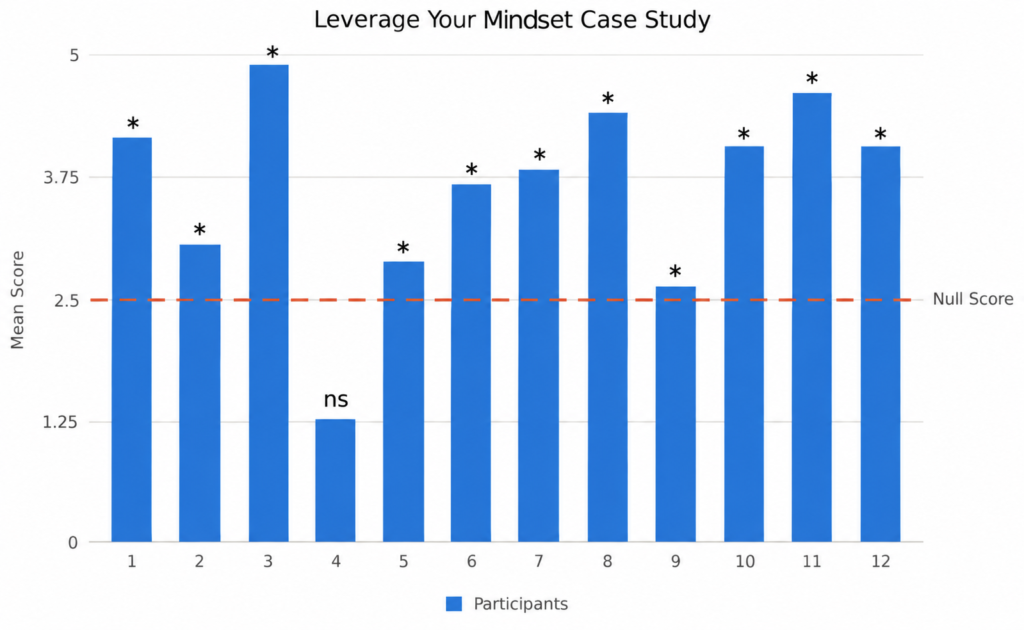
Figure 1. Mean scores for the 12 employees who completed the study. Score scale: 0 – 5: A score of 2.5 represented no change (the Null hypothesis); scores above 2.5 represented positive change; scores below 2.5 represented negative change. (Key: *=p<0.01; ns = nonsignificant, p’s>.05)
Detailed analysis of the responses to individual questions revealed a relatively homogenous pattern across the 25 questions. Figure 2 shows for 7 representative questions, the percentages of employees reporting scores representing positive changes for the respective question. Overall, the percent of individuals reporting scores that represented positive changes ranged between 83% and 92% for any one question (p’s ranged from 0.03 to 0.001). In a few instances, responses to a question trended toward positive change, but missed significance, e.g., ‘Reduced Self-Doubt’ (p=0.18, 2-tailed, 0.09 1-tailed).
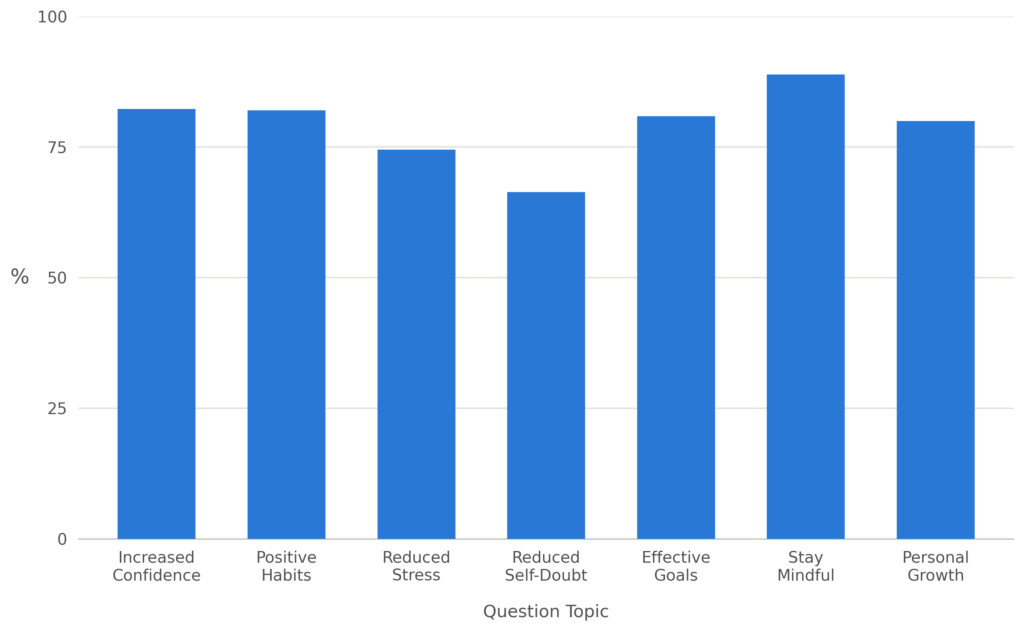 Figure 2. Seven representative questions from the 25-item questionnaire. Bars indicate the percent of employees reporting positive change scores for the respective question. For six of the seven questions, 75% or more of employees reported positive change scores. For the middle question, 67% of employees reported positive change scores.
Across the 25 questions, 8 participants (67%) reported average scores of 3 or above per question (p<0.001). The remaining four participants obtained average scores per question of 2.9, 2.8, 2.6, and 1.2 (p=0.08).
Discussion
This feasibility study found strong evidence that employees in a large global hospitality company who voluntarily participated in the Leverage Your Mindset Program, reported significant positive changes in a wide range of measures involved with well-being and performance (Figs. 1 and 2). Moreover, the changes were long-lasting; the questionnaire was not administered until 13 weeks after the start of the program. Most participants reported scores representing overall increased confidence and reduced stress. Their scores also evidenced meaningful, lasting positive changes in their daily habits and thought patterns: Many participants endorsed responses describing increased awareness of automatic responses and replacing those with deliberately chosen more constructive, purpose-driven behaviors. Overall, the reported positive changes were highly significant, both behaviorally and statistically: Eight of the twelve employees reported clear and significant positive changes. The scores for three of the four other employees were representative of positive changes, but they did not reach statistical significance. One employee reported scores that reflected negative change or no change.
Mindset training has been reported as effective in helping participants recognize and replace limiting beliefs with constructive, purpose-driven thoughts (Dweck ref). The findings reported here are consistent with other reports that even small shifts in perspective can significantly alter an individual’s direction, increasing confidence and supporting the pursuit of a more empowered self (ref).
The Leverage Your Mindset program proved effective in delivering strong, positive impacts on a wide range of behaviors and emotions. personal and professional transformation. By reframing perceptions and beliefs, individuals can become better equipped to meaningfully balance two areas of life that are often closely intertwined – personal life and work life. In terms of personal life, this study underscores the power of structured mindset practices to help individuals reprogram their awareness and replace automatic, limiting responses with intentional, growth-oriented habits. By recognizing the role of mindset in framing reality, participants were able to initiate shifts in perspective that enhanced their confidence and empowered them to function more effectively (ref).
Additionally, the study suggests clear benefits for corporate culture and organizational growth. Companies that integrate mindset training into employee development programs may see improved collaboration and teamwork, increased resilience in facing challenges, and a more motivated and engaged workforce. These advantages support a stronger, more adaptive corporate environment that fosters innovation and productivity. For example, One reason organizations seek to build collaborative cultures is to enhance the opportunity and motivation for employees to help and work more effectively with each other. An interesting question is whether work growth mindset influences other-directed behaviors, i.e., do employees engage in helping each other more? A recent series of published studies (B. Rogers, J. Christian, et al., 2023) showed evidence that a work mindset intervention resulted in employees becoming more other-oriented and likely to help each other. Employees who are disengaged at work and acting in their jobs in a perfunctory manner, are not manifesting in their work their true identities, thoughts and feelings (Kahn, 1990). By contrast, given the core premise of mindset, engaged employees harness themselves to what they are doing by fully investing their heads, hearts, and hands in performing their role (Rich, Lepine & Crawford, 2010).
The positive outcomes exhibited by employees in the present study could help foster employee-development programs and facilitate enhanced working environments useful for commercial and business organizations. The value-add of small efforts such as offering structured mindset training with follow-up reinforcement to sustain habit change, could have significant positive impact on employee satisfaction, retention, and productivity. An additional idea might involve promoting the integration of mindset training into corporate-level development programs to enhance workplace culture and leadership performance.
This study had limitations, including a small sample size, partly because it was conducted during a lengthy holiday period. Indeed, the attrition of participants was due in large part to employees indicating the holidays as reason for dropping out. While 13 weeks was a reasonable time to look at longer term effects of having participated in the Mindset Program, future studies could consider longer study durations and assessments at periodic time points to determine waxing and waning of the longer-term impact of the training. Because of the requirement for anonymity, both by Company G and by the volunteer employees, we could not interview participants post-study to obtain personal perspectives and experiences during the course of the 13 weeks, or to obtain various net-promoter types of information. All of these limitations can be effectively managed in future studies.
As a final consideration, there is a complex link between mindset and neuroscience. A recent review has begun to unpack insights into the dynamic interaction between mindset and neural processes (R. Meylani, 2024). Further understanding of this linkage potentially opens the door to the possibility that managing mindset could become an important intervention in improving areas of cognitive function. Explorations and discoveries about how mindset can change the brain raise opportunistic applications for academic achievement, healthcare, and for work environments as well, for example, examining the neural foundations of emotional regulation and its impact on mindset, resilience, and stress response.
Acknowledgements
We thank the following undergraduate students for their research contributions in obtaining, reviewing and discussing the findings from all of the background papers and references referred to in the Introduction and the Discussion sections of this paper: Cam Newell, Nedum Ebo, Joseph Ahn, Remy Chritah, and Teo Sheth, all members of The Life Sciences Consulting Group, and junior-year or senior-year students at Emory University, College of Arts and Sciences; and Oluwadamilare Adekun, Master’s Program student, School of Public Health, Morehouse College, for her contribution to the Introduction and Discussion.
Neither Dr. Stuart Zola nor any of the students mentioned has any financial, business, or entrepreneurialrelationship with Mr. Kalmon or Kalmon Productions, LLC.
Contributions
Ricky Kalmon: – conceived of the idea to develop an assessment of his Leverage Your Mindset Program; outlined the framework, drafted some of the early and later versions of the Introduction and Discussion. Contributing throughout to the final text version of the paper. Initiated contact with Company G, arranged for meeting dates, supervised all interactions with Company G and the employees in the study, developed the 25-item Mindset Questionnaire, supervised emailing and receipt of questionnaires. Arranged for Company G to pay IRB expenses.
Dr. Stuart Zola – Assisted Mr. Kalmon in framing the feasibility study, helping with the kinds of assessment tools and questions that would be appropriate, supervising the IRB process, overseeing the Life Science Consulting Group students and the Morehouse student engaged in the preparation of the paper, overseeing the organization of the data and the statistical analyses, and preparing the initial drafts of illustrations of findings. Contributing throughout to the final text version of the paper.
About the Authors
Ricky Kalmon
Kalmon is the author of Leverage Your Mindset (Sound Wisdom Publishing, Shippensburg, PA, 2020), a mindset expert, motivational keynote speaker, and celebrity hypnotist. Leverage Your Mindset is a series of books, with the newest release, Leverage Your Mindset for Golfers, achieving #1 New Release in Sports Psychology on Amazon. Kalmon is also the developer of the growth mindset and meditation app titled Ricky Kalmon. He works with Fortune 500 companies and sports teams, teaching them how to turn intentions into successful accomplishments to enhance results. Known for delivering high-energy, interactive keynotes that blend entertainment with practical strategies, he provides audiences with actionable tools to reduce stress, improve performance, and achieve greater success. Kalmon also offers customized coaching and training programs for executives, sales teams, and athletes, helping them strengthen focus, build resilience, and unlock their full potential. He is the founder and CEO of Kalmon Productions, LLC.
Dr. Stuart Zola
Credentials: University of Massachusetts, BA, Psychology. Northeastern University, MA, Clinical Psychology; PhD, Neuroscience. Professor Emeritus, Psychiatry and Behavioral Sciences; Authored 125 peer-reviewed scientific papers, monographs, and book chapters. Leadership Positions: UCSD: Director, Neuroscience Graduate program; Emory University: Director of National Institute of Health Nonhuman Primate Research Center, Interim Provost and Vice-President Academic Affairs, Innovator in Residence, Emory Hatchery Center for innovation; Veterans Administration Hospital: Senior Research Scientist, Emeritus Deputy Associate Chief of Research. Founder and Co-Founder of Quiet Developments, LLC, NeurotrackTechnologies, Inc., and MapHabit, Inc.
References
Bandura, A. (1997). Self-efficacy: The exercise of control. W. H. Freeman.
Dweck, C. S. (2006). Mindset: The new psychology of success. Random House.
Gallup. (2025). State of the global workplace: 2025 report. Gallup.
Kahn, W. A. (1990). Psychological conditions of personal engagement and disengagement at work. Academy of Management Journal, 33(4), 692–724. https://doi.org/10.5465/256287
Kalmon, R. (2020). Leverage your mindset. Sound Wisdom.
Meylani, R. (2024). Exploring the link between mindset and neuroscience—Implications for personal development and cognitive functioning [Unpublished manuscript]. Retrieved from https://www.researchgate.net/publication/374275450
Rich, B. L., Lepine, J. A., & Crawford, E. R. (2010). Job engagement: Antecedents and effects on job performance. Academy of Management Journal, 53(3), 617–635. https://doi.org/10.5465/amj.2010.51468988
Rogers, B. A., Christian, J. S., Jennings, R. E., & Lanaj, K. (2023). The growth mindset at work: Will employees help others to develop themselves? Academy of Management Discoveries, 9(1), 67–92. https://doi.org/10.5465/amd.2021.0144
Welch, J., & Welch, S. (2005). Winning. HarperBusiness.